
Recent incidents suggest these safeguards perform well in simulated conditions and mock drills, but often fall short when actual threats emerge.

The Reserve Bank of India on Monday directed all banks and financial institutions to provide information and documents sought by the Special Investigation Team (SIT) set up to unearth black money.

The banking sector's credibility is on thin ice. Unless the government takes strict steps, things could get worse.

The appeals came against orders of the Central Information Commissioner in various cases.

The Reserve Bank on Friday said it will soon commence the pilot launch of e-rupee for specific use cases with a view to bolstering India's digital economy, making payment systems more efficient, and checking money laundering. In a concept note on Central Bank Digital Currency, the RBI said CBDC is aimed to complement, rather than replace, current forms of money and is envisaged to provide an additional payment avenue to users, not to replace the existing payment systems. "Supported by state-of-the-art payment systems of India that are affordable, accessible, convenient, efficient, safe and secure, the Digital Rupee (e?) system will further bolster India's digital economy, make the monetary and payment systems more efficient and contribute to furthering financial inclusion," the paper said.

'A weak monsoon always spells disaster. But it's too early to have a pessimistic view.'
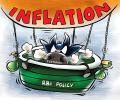
The RBI's Monetary Policy Committee brainstormed the impact of any future shocks on the inflation trajectory and stressed monitoring the cumulative effect of monetary policy actions over the past one year, which is still unfolding, revealed minutes of the rate-setting panel released on Thursday. The minutes of the meeting of the Monetary Policy Committee (MPC), headed by Reserve Bank Governor Shaktikanta Das, also indicated it would be premature to declare an end to the monetary tightening cycle, which started in May 2022 to check high inflation following the outbreak of the Russia-Ukraine war. The central bank, which effected six back-to-back hikes in the key short-term lending rate (repo) since May 2022 to check high inflation, decided to take a pause early this month.

Investors are pushing back more often against companies' resolutions on what is paid out to top executives. In the first four months of financial year 2022-23 (FY23), there have already been five such rejections, according to shareholder voting data from tracker Adrian, a platform maintained by the proxy advisory firm Institutional Investor Advisory Services India (IiAS). Two of these have been at multiplex chain PVR and direct-to-home company Dish TV India.

The government has revised its divestment target downwards from Rs 2.1 trillion, as its ambitious privatisation programme has been deferred to next year.

India's rank inched up by just one position to 130 in last year's Doing Business Survey by the World Bank.

The Securities and Exchange Board of India (Sebi) has proposed measures mandating daily upstreaming of all investor funds from stockbrokers to clearing corporations (CCs). The step, aimed at reducing risk on client funds, will further deplete brokers' revenues as they will lose interest income with transfers being done daily. At present, stockbrokers convert the surplus funds into bank guarantees (BG) or fixed deposit (FD) receipts which earns them extra income.

There is a sharp difference between the total remuneration paid at the public sector and private sector entities

Modi has been relentless in building his brand regardless of banks having a problem of fraudulent and unauthorised transactions with his companies.

'NSE has thousands of employees. It is their institution. So it's a dear family.' 'One should not hurt the morale of these people.'

China's intended role for AIIB is not so different from the existing Western lenders like the World Bank.

The Supreme Court had observed that issues of national economic interest; disclosure of information regarding currency or exchange rates/interest rates/ taxes; regulation or supervision of banking, insurance and other financial institutions; proposals for expenditure or borrowing, and foreign investments, could all, in some cases, harm the national economy, especially if released prematurely.

The credit guarantee cover under the scheme would be both transaction-based (for single eligible borrowers) and umbrella-based (for a group of eligible borrowers).

Women politicians bring to politics and policy a sensitivity that most of their male counterparts, at least until a generation back, lacked.
Delays in returning money for disputed transactions have also come under RBI's scanner.

Sundararaman Ramamurthy has been an interesting choice for the publicly-listed BSE, which has seen its chief move to bigger rival -- the National Stock Exchange (NSE) -- in July. Having spent nearly two decades at the country's largest bourse, Ramamurthy is among the early architects of NSE and understands all the cogs of the exchange wheel like only a few others in the country. Just like NSE's core team, which includes its founder RH Patil, the 59-year-old Ramamurthy has worked at the Industrial Development Bank of India (IDBI) before moving to NSE in 1995.

'But he was very quick and did a very stylish adab.' 'Of course, I didn't expect him to hug.'

The highest salary rose by 14.22 per cent from last year.

The Finance Ministry has invited private sector bankers.

The IPO-bound national insurer LIC is not only the largest holder of government debt -- owning 19 per cent of the G-secs -- but also the single largest owner of equities, the largest fund manger as well as holder of household savings, dwarfing even SBI deposits, as per a report. Holding 17 per cent of the over Rs 80.7 lakh crore dated government securities, maturing by 2061, the Reserve Bank is the second largest holder of government debt, while led by public sector banks, commercial banks collectively own around 40 percent. Other insurers cumulatively own only 5 per cent.

'The Fed rate will peak in the range of 5.1-5.3 per cent during the second quarter of CY23 and will most likely stay there for a while before rate cuts start in CY24.'

What was the RBI doing, what was the PNB top management doing, what were the auditors doing, asks Debashis Basu.

While the total disbursement of housing loans by PSBs as well as HFCs witnessed a deceleration in 2016-17, there was significant growth for the lower slabs

In Delhi, Union Home Minister Amit Shah assessed the situation in Joshimath and steps taken to ameliorate people's hardship at a meeting attended by Union ministers Nitin Gadkari, R K Singh, Bhupendra Yadav and Gajendra Singh Shekhawat and top officials.

Banks cannot shirk their responsibility in cases of frauds.

Fresh buying by domestic institutional investors and better-than-expected June quarter results from some blue-chip companies boosted investor sentiment

The Department of Post, Tech Mahindra, Videocon Group and stock exchange NSE have joined big corporates like Ambanis and Birlas to seek entry into banking business through newly created niche category of Payments and Small Finance Banks.

Bankers seem to be pleased with the government for keeping its promise of not interfering in operational matters, but are apprehensive about the intense scrutiny of their functioning.
Reserve Bank of India Governor Raghuram Rajan had said recently that there was "no need" to set up a separate bad bank to deal with stressed assets of public sector lenders.

Citing national security and confidentiality clauses, the Finance Ministry has declined to disclose information on exchange of correspondence among India, Swiss and German authorities in connection with the black money probe.

Merely bringing down the government stake below 51% may not find any taker for the PSBs. The government must bring down its holding to at least 26%, recommends Tamal Bandyopadhyay.

According to a nation-wide survey on financial behaviour, India has the highest account dormancy rate even more than countries like Kenya, Tanzania, Uganda, Nigeria, India, Pakistan and Bangladesh.

7 key areas that the Budget must address to re-energise the infrastructure sector, suggests Vinayak Chatterjee.

'Modi wants to reverse everything Nehru did, but is shy of touching his daughter's most unwise policies.' 'There is no example of this more stark than bank nationalisation,' says Shekhar Gupta.

'The entire public needs to be evacuated immediately. Any day, the entire town can collapse.'

India's dream to be in the forefront of international politics has come true. India has placed itself firmly as a major player in the shaping of a new world order, observes Ambassador T P Sreenivasan.
 © 2026 Rediff.com - Advertise with us - Disclaimer - Privacy Policy - Sitemap - Feedback - About us - Terms of use - Grievances